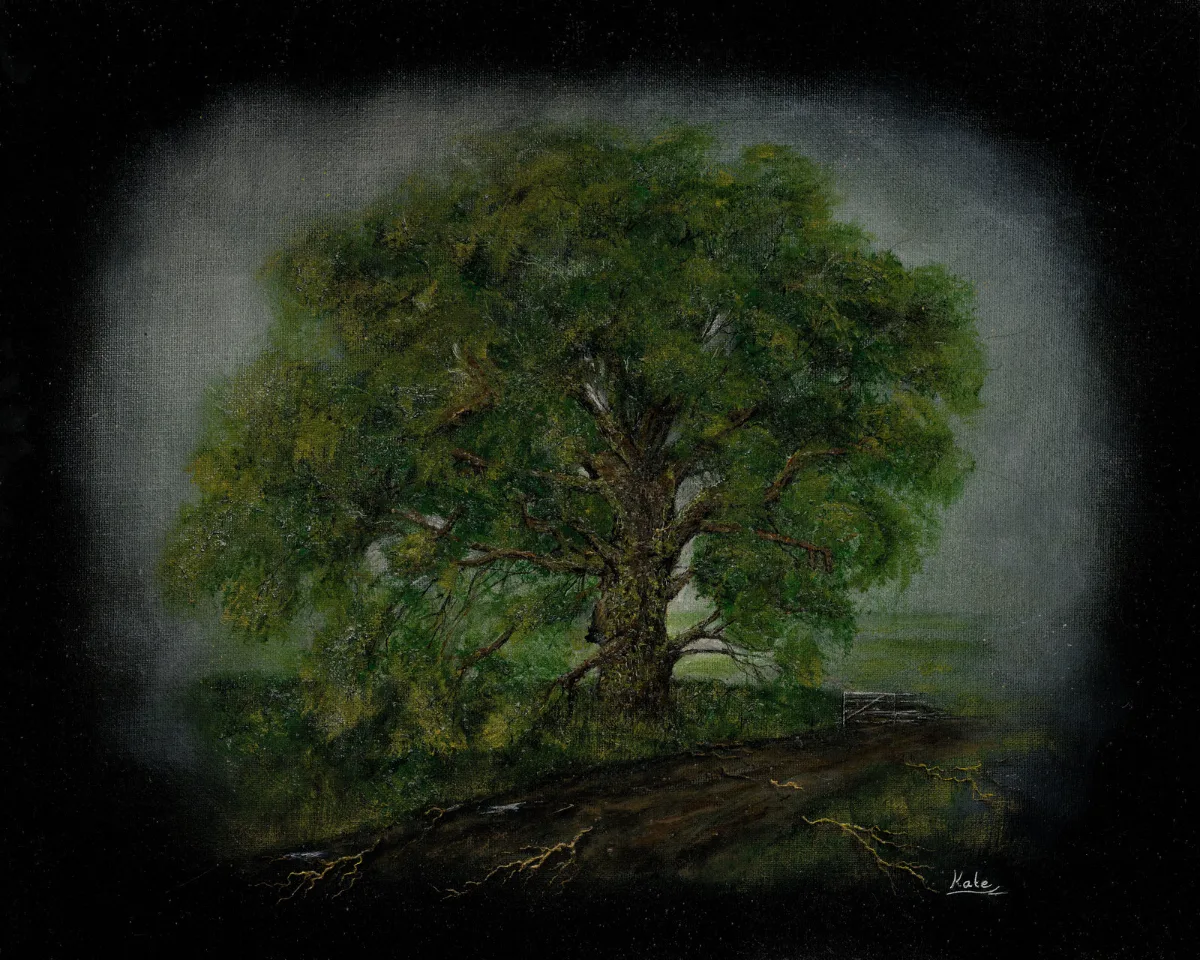
St Newlyn East
An Important Elm
Original · not for saleOnce a towering emblem of the English countryside, the English Elm (Ulmus procera) now stands as a ghost of its former glory, its decline is a tragic tale. For centuries, these majestic trees lined hedgerows, shaded lanes, and graced village greens, their sweeping branches and deeply fissured bark woven into the cultural and ecological fabric of Britain. But in the 20th century, Dutch Elm Disease—spread by bark beetles and caused by a virulent fungal pathogen—swept across the nation with ruthless efficiency.
Despite desperate efforts to halt its spread, over 25 million elms succumbed, their skeletons left to rot in silent testimony to a vanished age. Today, few mature English Elms survive in the wild.
But in the lanes around the parish of Newlyn East, there is a rare sight … a few very mature large elms and a slight variant of the English Elm. They are Ulmus obtusifolia, a very uncommon variety which is not well-documented in the UK. And they have proved resistant to elm disease.
This tree is one of many mature elms in the parish that have escaped elm disease despite other elm species dying around them. The largest is over 5m girth! Cornish forester, Colin Hawke first became interested in these elms in the late 1980’s, and has fond memories of his family walking the paths and fields surrounding this elm. He has been using the seeds from this tree to grow seedlings with the hope of repopulating Cornwall with more of this majestic giant.

 Listen now
Or scan the code with your phone
Limited edition print of this painting
Numbered, signed and hand-embellished by Kate · limited to 50